


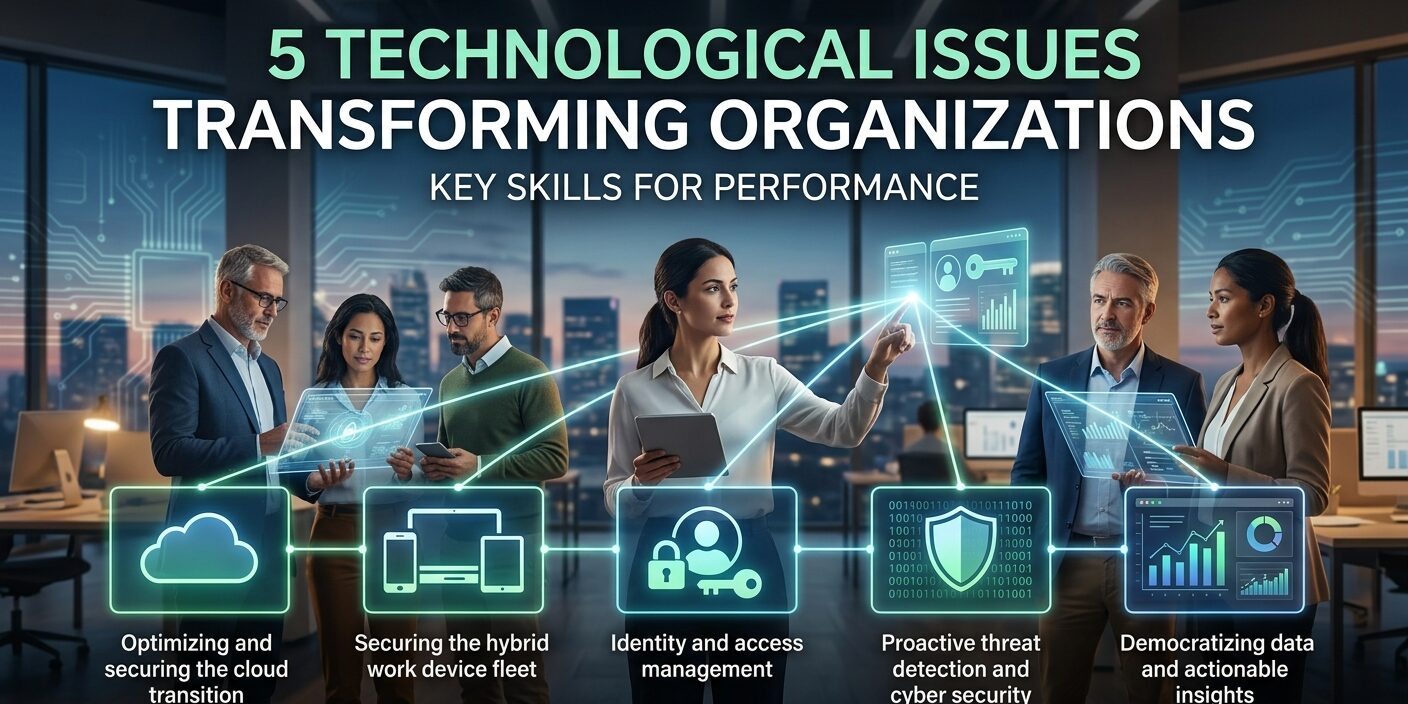
Skills That Support High-Performing Organizations
For IT Managers, HR Leaders, and Decision-Makers.
Technologies evolve rapidly, but the challenges often remain the same.
Ensuring operational security, supporting users, managing complex environments, and turning data into useful insights remain at the core of organizational priorities.
Whether involving cloud migration, cybersecurity, hybrid work, or data optimization, companies must continuously develop their technical and strategic skills to stay efficient, secure, and adaptable to change.
Behind every technological challenge lies above all a human and organizational issue: modernizing infrastructure, protecting access, supporting team mobility, strengthening cyber threat prevention, and effectively leveraging available information. Investing in the development of technical and strategic skills not only addresses these challenges but also better prepares the organization for upcoming transformations.
5 Strategic Challenges for IT Teams
- Optimizing and securing the transition to the cloud
- Effectively managing devices in a hybrid work environment
- Strengthening security through rigorous identity and access management
- Detecting and countering cyber threats before they impact operations
- Turning data into actionable insights for decision-making
FIVE SKILL AREAS DIRECTLY CONTRIBUTING TO ORGANIZATIONAL PERFORMANCE
1 – Optimizing and Securing the Transition to the Cloud
Organizations are looking for professionals capable of planning, administering, and scaling hybrid or cloud infrastructures while maintaining high standards of security and governance.
Cloud migration is not just about moving data. It requires rigorous management of resources, security, access, and costs.
Organizational Benefits
- Operational cost optimization.
- Increased agility and business continuity without interruption.
Key Skills
- Administration of hybrid infrastructures.
- Management of Azure/AWS resources.
- Change management support for teams.
Suggested Training
- AZ-104 Azure Administrator
- AZ-800 Windows Server Hybrid Infrastructure
2. Securing the Device Fleet in a Hybrid Work Context
In a mobile and remote work environment, endpoint management has become a strategic issue. Securing the fleet of devices in a hybrid work environment requires centralized management and becomes a key element of productivity and data protection.
Organizational Benefits
- Reduced work disruptions for mobile users and enhanced protection against equipment loss or theft.
Key Skills
- Remote deployment and configuration.
- Endpoint security.
- Employee awareness of mobility best practices.
Suggested Training
- MD-102 Endpoint Administrator
3. Reducing the Attack Surface Through Rigorous Identity Management
Digital identities are now one of the primary targets for cyberattacks. Organizations are placing growing importance on access control, authentication, and user account protection.
Access control is a crucial component of a modern security strategy. Reducing the attack surface through rigorous identity management serves as the first line of defense against intrusions, making strict access control and account governance a top priority.
Organizational Benefits:
- Compliance with regulatory requirements and prevention of unauthorized access to sensitive data.
Key Skills:
- Identity and Access Management (IAM).
- Multi-Factor Authentication (MFA).
- Internal communication on security culture.
Suggested Training:
- SC-300 Identity and Access Administrator
4. Moving from Reactive to Proactive Security
Security teams must now detect threats faster and intervene before they affect operations.
Moving from reactive security to proactive response against cyber threats. Rapidly detecting anomalies and automating incident response neutralizes cyber threats before they paralyze the organization.
Organizational Benefits:
- Brand reputation protection and avoidance of financial losses related to service downtime.
Key Skills:
- SOC monitoring.
- Threat analysis.
- Incident response.
- Crisis management and cross-departmental collaboration.
Suggested Training:
- SC-200 Security Operations Analyst
- SC-300 Identity and Access Administrator
- SC-401
- AZ-500
5 – Democratizing Access to Data to Accelerate Decision-Making
Data creates value when it becomes accessible, understandable, and actionable for teams. Organizations hold a growing volume of data, but it must be transformed into useful and accessible information.
Democratizing access to data accelerates decision-making. Converting raw data into visual and accessible dashboards helps enlighten decision-making at all levels of the company.
Organizational Benefits
- Time saved in decision-making.
- Better alignment among strategic and HR teams.
Key Skills
- Analysis and modeling with Power BI.
- Creation of Key Performance Indicators (KPIs).
- Data translation / popularization.
Suggested Training
References
Microsoft Learn: Official guide for certification paths (AZ-104, MD-102, SC-300, SC-200, PL-300)
- Gartner & Microsoft Security Reports: Trend analyses in cybersecurity, identity management, and cloud transformation